By Dr Chris Withnall. First published in our October 2026 newsletter. Next review 1 October 2027.
“Trust is choosing to risk making something you value vulnerable to another person’s actions.”
Charles Feltman, The Thin Book of Trust (2009)
The quote above really resonated with me. As a GP I hold an immensely privileged position of trust in my patients’ lives. As a business owner, the staff, doctors and patients of the clinic trust me to run things well. And as a health service, the community rely on us for far more than prescriptions.
Feltman’s book is written for managers, but his main point works anywhere. When we say “I don’t trust X”, we mean one of four things, and we usually have not worked out which.
Sincerity. Do they mean what they say?
Reliability. Do they do what they said they would?
Competence. Can they actually do it?
Care. Are my interests in the picture, or only theirs?
The four are separate. A plumber can be honest, care about you, and never turn up. A colleague can be brilliant and reliable and only ever thinking about themselves. We mix them up constantly: warmth read as skill, bluntness read as not caring. Social media and AI are making it harder to know who to trust. Both are very good at sounding sincere and competent. But do you trust them to be reliable, or to hold your interests?
It cuts both ways. When you are the one trusting, the question is not whether you trust someone but which of the four you are trusting them with. When you are the one being trusted, the same four tell you what you have been handed. And when trust breaks, it is nearly always one of the four that has broken, not the whole person. “I don’t trust him” closes a door. “He is honest and he is good at this, but he has let me down twice on timing” can be said to his face, and he can do something about it. Most broken trust is one broken part, and one broken part can be repaired.
How do we stack up?
We recognise that every appointment is you trusting us with something you value, your health. So here are our answers, including where we fall short.
Sincerity.
In general practice the honest answer is often “I am not sure yet, and here is how we find out.” You are entitled to hear that and to be told when a test is not worth doing, not a confident guess or a useless investigation. Radical candour, not an empty platitude.
In the room it looks like this. If we think the cough is a virus, we say so and say why, rather than writing the script that ends the conversation. If you ask for a scan that will not change what we do, we tell you that, and what would change our mind. If a result is worrying, you hear the word, not a softer one. And when we do not know, we say so, then say what we will do together to find out.
Competence.
Gum Medical is accredited against the RACGP Standards and is an accredited training practice. Both mean someone outside the practice checks how we work, and that our doctors are trusted to teach the next generation of GPs. All staff actively engage in continuing professional development. We actively seek feedback and act on it. When something is outside our expertise, we admit it.
Reliability.
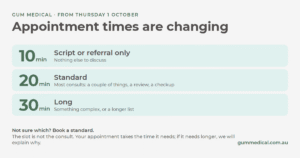
This is where we fall short most. We run late. Some of that is the work: the person before you needed longer than expected, and one day that person may be you. Some of it was our booking system, fitting more care into a slot than the slot could hold. From 1 October 2026 the appointment book changes so that what we book matches the time we spend. The details are in our note on the new appointment times. It will not fix every late appointment. It will fix the lateness that was baked into our appointment grid.
Care.
This one is hard for us too.
Continuity. The best general practice is one doctor knowing you over years, and we cannot always give you that. Doctors have retired, new doctors have joined, and every doctor takes holidays and has family commitments. Booking ahead makes a relationship with a regular GP much more likely. When you cannot see your own doctor, we work as one team: every doctor here works from the same record, and you can ask for your usual doctor when you book. That is not the same as a doctor who has known you for a decade, and I will not pretend it is.
Cost. We cannot bulk bill all appointments, and for some people the gap is the reason they do not come. If cost is keeping you away, tell your doctor. Our article on why some visits are bulk billed and some are not explains how that decision is made.
All ways
Trust runs in every direction here. You hand us something you value. And the community trusts the clinic to be here next year. In return we ask for an honest history, the follow-up you meant to book, and a call when the plan is not working rather than quietly stopping.
We invite you to run the four questions on us. If one answer is no, tell us which one. “I don’t trust them” gives us nothing to work with. “You were not on time” or “you did not listen” is something we can fix.