By Dr Chris Withnall. First published in our May 2026 newsletter. Reviewed 1 September 2026. Next review 1 September 2027.
Most weeks, someone walks in with a story that goes like this. The shoulder, the knee, or the back has been niggling for a few months. They have had a scan. The scan has found a tear, a bulge, a fray, a touch of arthritis, a shred of bursitis. The patient has been told that what the scan shows is what is wrong, and that they probably need a procedure to fix it.
The story is so common we should pause on it, because the way it is framed often misses the actual driver.
What the imaging literature shows
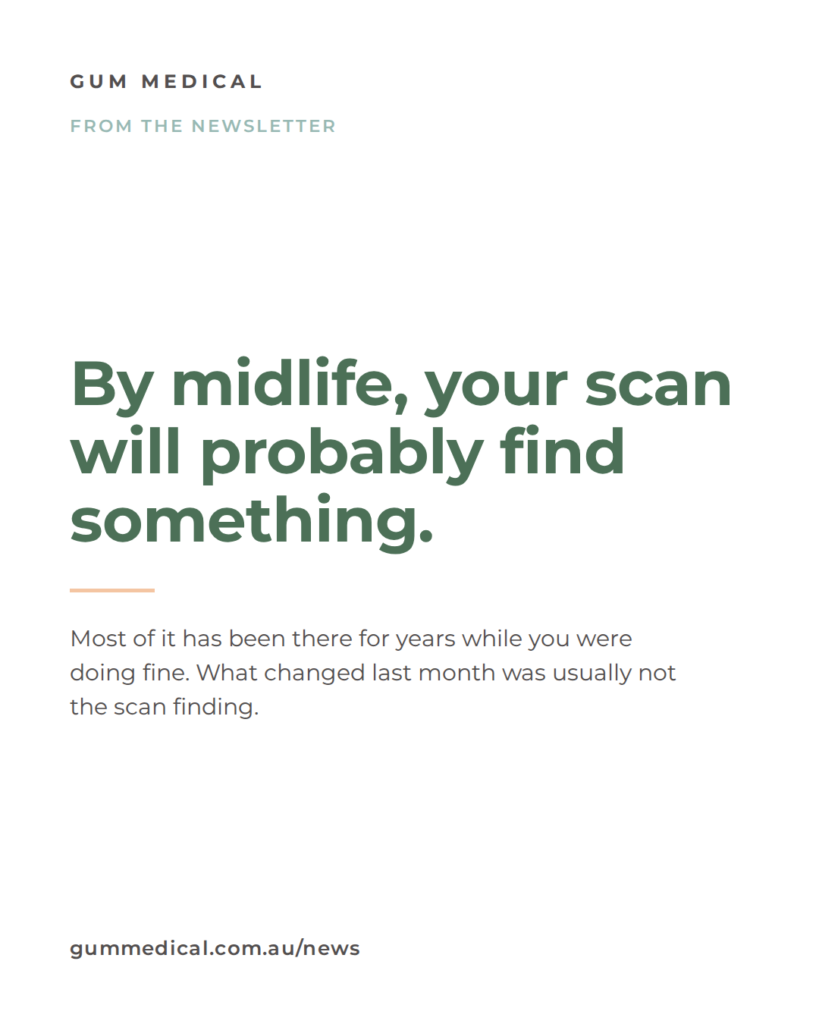
We have known for a long time, but it does not get into everyday conversations enough, that the kinds of findings MRIs reveal are extremely common in people with no pain at all. Studies of pain-free adults find rotator cuff tears in around a third of people over 50 and around half over 60. Disc bulges are visible on the scans of around two thirds of people over 50 with no back pain. Meniscal changes in the knee follow a similar pattern. By midlife, your scan is likely to find something. That something has often been there for years, sitting quietly, doing no harm.
Which raises the obvious question. If the imaging finding has been there for a while, why did the pain start last month?
The thing the scan does not show
Your body has what physiologists call physiologic reserve. Strength, tendon capacity, aerobic capacity, balance, recovery. Reserve is the gap between what your body can comfortably handle and what it is asked to handle on a given day. In your twenties and thirties the gap is generous. In your forties, fifties, and sixties, the gap quietly closes if you do not attend to it. Strength fades, tendons stiffen, recovery slows. For years the body compensates. Then one ordinary day, capacity meets load, and the niggle becomes a symptom.
The MRI did not cause this. The MRI is just there to take the photograph, and the photograph happens to find the structural change that was there all along. The thing that actually tipped you over was not the change on the scan. It was the closing of the gap between what your body can do and what you are asking it to do.
This matters because the framing changes what you do next. If the scan finding is the cause, you fix the scan finding. If reduced capacity is the cause, you rebuild capacity. Different conversations, different plans, different outcomes.
When the scan is the answer
There are real exceptions, and they matter. A scan finding can be the cause of pain. Sometimes a procedure is the right call. The signal that imaging and a specialist opinion are urgent rather than optional includes:
- Recent significant trauma (a fall, a crash, a sporting injury)
- Pain that wakes you at night and will not settle in any position
- Unexplained weight loss alongside the pain
- New weakness, numbness, or loss of bladder or bowel function
- Fever along with the pain
If any of those are present, please come in soon, or go to an emergency department.
What this means for you
If you have got an ache that has been niggling for months, you have had a scan, and the scan found something, the most useful question to ask your GP is not “what does the scan show”. It is “what is the whole picture”. Strength, activity, weight, sleep, metabolic health, and targeted rehab often do more than a procedure for the kinds of midlife pain most people walk in with. None of this is glamorous. It is slow. It is steady. From little things, big things grow.
Book an appointment online or call 8389 1009 to talk through a whole-picture plan.